

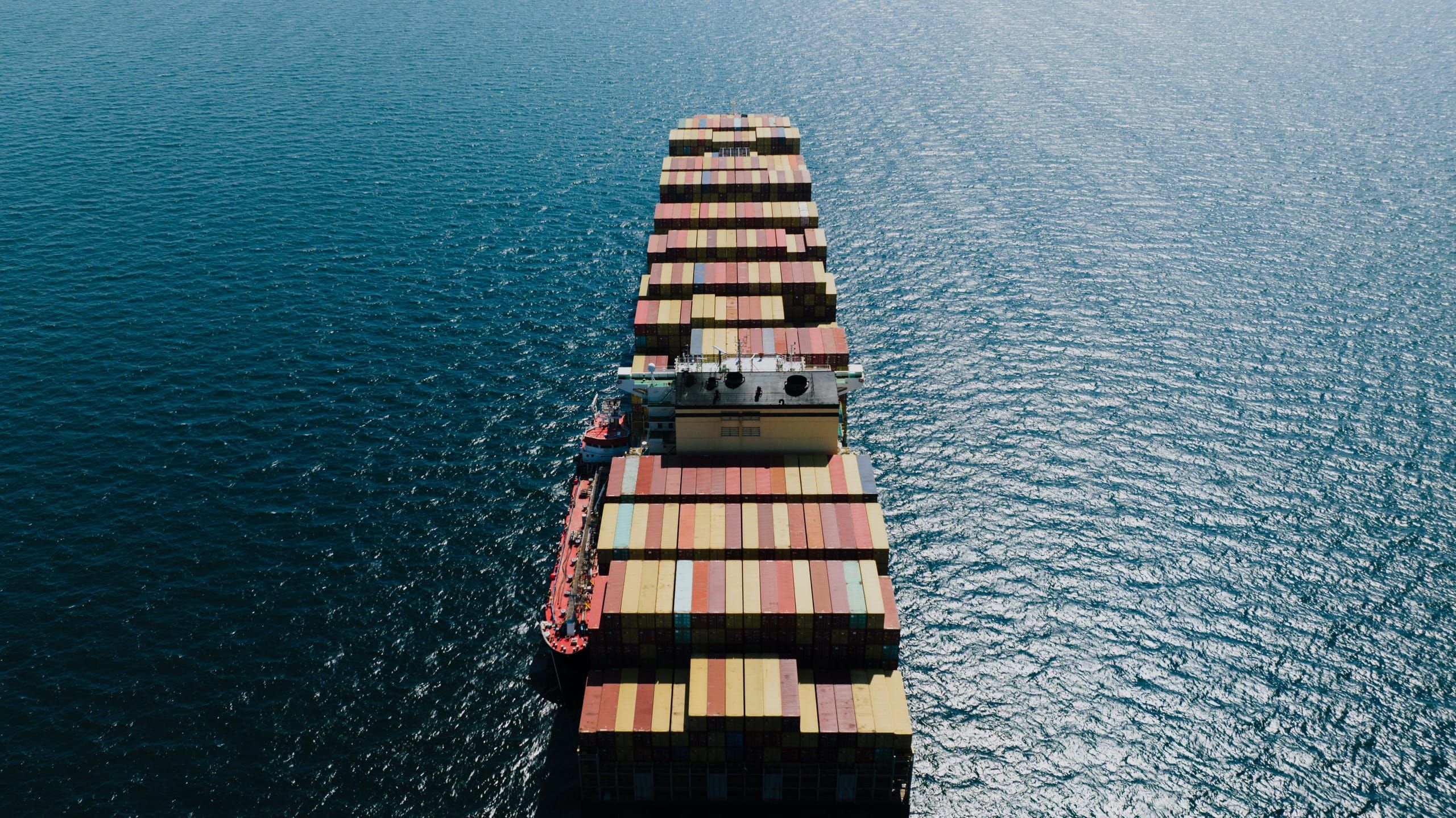
FCL (full container load) means a whole container for your goods only, at a rate per container. LCL (less than container load) means your goods share a container with other shipments, and you pay for the space they use. As a rule of thumb, Maersk's guide puts the dividing line at about 15 m³: below that, a shared container is the usual choice; from about 15 m³, ask for quotes for both, because Maersk adds that a full container is sometimes more economical even when it is not full. Heavy goods, fragile or high-value goods, a fixed arrival date and orders from several suppliers can all tip the choice towards a full container.
What is the difference between FCL and LCL?
FCL is a container used for your goods only, and it suits larger volumes. LCL, or a shared container, means your goods share a container with other shipments, and it suits volumes that do not fill a container. These are the definitions on our sea freight page. In Maersk's description, an FCL container is booked by one shipper, even if it is not completely full, at a fixed rate per container, and it stays sealed from origin to destination. In LCL you pay only for the space your goods use, in cubic metres, and the logistics provider groups your cargo with other shipments before loading and separates it again at the destination.
| Full container (FCL) | Shared container (LCL) | |
|---|---|---|
| Who uses the container | Your goods only | Your goods and other shipments |
| Typical volume (Maersk rule of thumb) | About 15 m³ or more | Less than about 15 m³, or 2–3 pallets |
| How the freight is worked out | A rate per container | By the space your goods use (m³), or by their weight (tonnes) if that number is higher, on a weight-or-measure basis |
| Speed (Maersk) | Faster, fewer stops | Slower, involves consolidation; more susceptible to delays |
| Handling and risk (Maersk) | Sealed from origin to delivery; lower risk | More handling; higher risk exposure |
| Generators, engines, motorcycles, batteries | Prepared and declared before loading; the shipping line must accept them | The same rules, and the goods must also be compatible with the other cargo in the container |
When does a full container (FCL) make sense?
A full container makes sense from about 15 m³, when your goods are heavy for their size, when they should travel on their own, or when speed matters.
Your goods reach about 15 m³ or more
Maersk's guide recommends FCL for shipments of "typically 15+ CBM" (cubic metres), and its FAQ says FCL is the more cost-effective choice once your goods take up most of a container's space. Note that 15 m³ is less than half of the 33.2 m³ a 20 ft container holds: as Maersk puts it, FCL is "sometimes more economical" even when the goods do not fill the container. Treat 15 m³ as one carrier's rule of thumb, not as a fixed threshold; the rates quoted for your route at the time decide. Our advice: near or above 15 m³, ask for quotes for both options for the same cargo and compare them.
Hapag-Lloyd publishes these example figures for containers in its fleet:
| Container | Capacity (inside volume) | Maximum payload (weight of goods it can carry) |
|---|---|---|
| 20 ft standard | 33.2 m³ | 28,130 kg |
| 40 ft standard | 67.7 m³ | 28,750 kg |
| 40 ft high cube (taller than the standard 40 ft) | 76.3 m³ | 28,600 kg |
Hapag-Lloyd states that these figures are examples and that actual containers vary. You can rarely use every cubic metre: cartons leave gaps, pallets take space, and some goods cannot be stacked.
Your cargo is heavy for its size
In a shared container, freight can be charged on a weight-or-measure basis: the number of tonnes is compared with the number of cubic metres, and the higher number is charged. So goods heavier than 1,000 kg per m³ are charged on their weight. For example, 12 m³ of goods weighing 20,000 kg would be charged on 20 tonnes, not on 12 m³. In a full container you pay a rate per container instead, and in Hapag-Lloyd's figures those goods use about a third of a 20 ft container's space and about 71% of its payload. Heavy goods can therefore make a full container worth pricing below 15 m³.
Weight also limits the container itself. In Hapag-Lloyd's figures, a 40 ft container offers about twice the space of a 20 ft container but almost the same maximum payload. A 20 ft container reaches its payload before its space is full once the cargo weighs more than about 850 kg per cubic metre (28,130 kg divided by 33.2 m³), a different threshold from the 1,000 kg per m³ that decides how shared-container freight is charged. To check your goods, divide the total gross weight on your packing list (in kg) by the total volume (in m³).
Your goods should travel on their own
Maersk's guide recommends FCL for fragile, high-value or regulated goods, because the container stays sealed from origin to delivery, with fewer handovers. It also suits goods that should not share space with other cargo: some goods cannot be stowed together, and dangerous goods need segregation and the shipping line's acceptance, as our consolidation conditions state.
You need shorter transit times
Maersk's guide lists speed as a reason to choose FCL: fewer stops and no consolidation delays, while LCL is "slower, involves consolidation; more susceptible to delays". If your goods must arrive by a fixed date, weigh speed as well as price when you compare the two options.
When is a shared container (LCL) the better choice?
A shared container suits goods well under about 15 m³, and orders you want to ship in parts.
Smaller volumes
With LCL you pay only for the space your goods use. Maersk's guide recommends it for "less than 15 CBM or 2–3 pallets", and its FAQ says small boxes or palletised cargo are likely to cost less this way. On a weight-or-measure basis, light, bulky goods are charged on their volume.
Expect extra time and handling. Your goods are grouped with other shipments before loading and separated after arrival, and Maersk describes LCL as slower, with "more handling, higher risk exposure". Use strong export cartons or pallets, and label every package so it matches your packing list. The CTU Code, a code of practice from the International Maritime Organization (IMO), the International Labour Organization (ILO) and the UN Economic Commission for Europe (UNECE), gives detailed guidance on packing and securing cargo in containers.
Splitting an order into several shipments
LCL also lets you ship goods as they become ready, or start with a small first order from a new supplier, without waiting until you have enough to fill a container. Each part is then charged on its own volume and weight.
How do you estimate the volume and weight of your shipment?
Multiply the length, width and height of one carton in metres, then multiply the result by the number of cartons. Your packing list gives the dimensions and the number of cartons. Add up the gross weights of all packages to get the total weight.
Worked example (illustration only): 60 cartons, each 0.60 m × 0.40 m × 0.50 m and 18 kg.
- Volume of one carton: 0.60 × 0.40 × 0.50 = 0.12 m³
- Total volume: 0.12 × 60 = 7.2 m³
- Total gross weight: 18 × 60 = 1,080 kg
That is less than a quarter of the 33.2 m³ of a 20 ft container in Hapag-Lloyd's figures, and well below Maersk's 15 m³ rule of thumb, so a shared container is the natural starting point. On a weight-or-measure basis this cargo is charged on its 7.2 m³, because its weight in tonnes (1.08) is the lower number.
For goods of different sizes, work out the volume of each line of the packing list and add the results together. Include pallets and crates in both the dimensions and the weight.
A first quotation can start from estimates, but weights must be real before loading. Under the SOLAS convention (the International Convention for the Safety of Life at Sea), the verified gross mass of a packed container is a condition for loading it onto a ship, and the shipper states it in the shipping document, as the IMO explains.
What if your goods come from several suppliers?
We can combine goods from several suppliers into a single shipment when their weight, volume and compatibility allow it and loading rules permit. Four conditions decide whether goods can travel together, and one decides when they leave:
- Weight: the total weight must stay within the limits of the container and the carrier.
- Volume: the goods, with their packaging, must fit the space available.
- Cargo compatibility: some goods cannot be stowed together.
- Loading requirements: loading rules and restrictions apply to each container and each type of cargo.
- Supplier ready dates: the shipment leaves when the last supplier's goods are ready.
Two points matter for the FCL or LCL choice. First, add the volumes together. For example, an importer in Lebanon with three suppliers in China whose orders measure 9, 8 and 7 m³ has 24 m³ in total: well above 15 m³, and almost three quarters of a 20 ft container. Shipped together, those goods may suit a full container better than three separate shared-container shipments. This is an example only: for any route, our quotation confirms whether and how we can ship the goods.
Second, ask each supplier for its ready date before you choose. One late supplier holds back the whole shipment, so an order that will be ready much later may be better shipped on its own.
Goods bought from OTS and goods from other suppliers can be combined in the same way: in the quote form, choose "Both" under "Goods bought from".
We can store your goods before international shipping. Storage arrangements are discussed with each customer. Once storage is arranged, we tell you directly where the storage point is: your suppliers deliver the goods there, and they stay in storage until the container is loaded. More on storage before shipping.
Our quote form also asks which terms of sale (Incoterms) you agreed with your suppliers, for example:
- EXW (Ex Works): your supplier makes the goods available at its own premises or another named place, and does not have to load them or clear them for export.
- FOB (Free On Board): your supplier delivers the goods on board the ship at the named port of loading, and the costs and risks pass to you from that moment.
If you do not know your terms, tick "Not sure".
Which goods need special handling with either option?
Generators, engines, motorcycles and batteries need special handling in a full or a shared container. Tell us the fuel type, whether tanks will be drained and what batteries are included. These goods must be prepared and declared before loading, and the shipping line confirms acceptance. Declared cargo follows specific preparation, documentation and stowage rules, and it can affect whether consolidation is possible. We confirm what we can accept.
The international rules for dangerous goods carried by sea in packaged form are in the IMO's International Maritime Dangerous Goods (IMDG) Code, which covers packing, stowage and the separation of incompatible goods.
Mention any of these in your request; the quote form asks about each:
- engines or engine-driven machinery, such as generators, pumps and compressors;
- motorcycles or other vehicles, such as 150 cc motorcycles;
- lithium batteries;
- oils, lubricants, chemicals, aerosols or gas cylinders;
- fragile, oversized or heavy items.
What should you send to get a quotation?
Send what you have. The list on our shipping page is:
- supplier names and locations;
- packing lists;
- commercial invoices;
- dimensions and weights;
- cargo type;
- destination port.
Estimates are fine at first. The more complete the details, the more precise the quotation.
Not sure whether FCL or LCL suits your goods? In the shipping quote form, tick "Not sure" under "Services needed" and give your estimated volume and weight. For goods you bought elsewhere, use the form for goods from other suppliers.
Where does OTS ship, and what is not included?
Our sea freight and logistics cover Lebanon, China, Dubai (United Arab Emirates) and the Democratic Republic of the Congo. This does not mean every route between them is available. Tell us where your goods are and the port of discharge, and our quotation will confirm whether and how we can ship them.
We ship by sea only, to the port of discharge agreed in the quotation. Customs clearance is not part of our services. Arrange it at the destination yourself or through a specialist you appoint.
Frequently asked questions
At what volume does a full container become cheaper than a shared one?
There is no fixed volume, but Maersk uses about 15 m³ as a rough dividing line, and heavy goods can tip the balance sooner. Maersk adds that the price depends entirely on your cargo, so near 15 m³ compare quotes for both.
Is LCL slower than FCL?
Usually, yes: Maersk describes LCL as "slower, involves consolidation; more susceptible to delays", while FCL has fewer stops. Maersk also links LCL to "more handling, higher risk exposure", so strong cartons or pallets are worth the effort.
How much fits in a 20 ft container?
About 33 m³ of space and about 28 tonnes of goods, in Hapag-Lloyd's example figures (33.2 m³ and 28,130 kg). In practice you can rarely use every cubic metre.
Can my goods share a container with other importers' goods?
Yes: that is what a shared container (LCL) is, and you pay for the space your goods use. The cargo must be compatible, though, and dangerous goods need segregation.
Can a generator or a motorcycle travel in a shared container?
It depends on the cargo and on the shipping line. These declared goods must be prepared before loading, can limit consolidation and need the shipping line's acceptance (see special handling above).
Do I need exact dimensions before I ask for a quotation?
No. You can start with estimates and tick "Not sure" for volume or weight in our quote form; real weights are needed before the container is loaded.
Sources
All pages read on 24 November 2026.
- OTS: Shipping & logistics (our own page)
- OTS: Request a quote, shipping form (our own page)
- OTS: Products, how consolidation works (our own page)
- Maersk: FCL and LCL compared (guide updated 8 May 2025)
- Maersk: LCL or FCL cost question (FAQ)
- Hapag-Lloyd: 20 ft standard container figures
- Hapag-Lloyd: 40 ft standard container figures
- Hapag-Lloyd: 40 ft high cube container figures
- WKO: sea freight terms (weight or measurement)
- HMRC (GOV.UK): Incoterms (guidance updated 14 April 2026)
- IMO: verified gross mass of packed containers
- IMO: dangerous goods at sea
- IMO: CTU Code for packing cargo transport units